The Triumph of Hope — And the Reality of Resolutions
Every year, right around New Year’s, the same pattern repeats.
A surge of optimism. A quiet sense of renewal. The belief that this will finally be the year things change.
Thanks for reading Performance Protocol AI! Subscribe for free to receive new posts and support my work.
“This is the year I’ll get healthier.” “This is the year I’ll get disciplined.” “This is the year I’ll fix my finances, my habits, my relationships.”
Nearly half of U.S. adults make at least one New Year’s resolution each year.
Hope is abundant.
Results are not.
---
Most Resolutions Don’t Last
The data is unambiguous:
- Roughly **80% of New Year’s resolutions fail by February**
- Only about **9%** of people who make resolutions succeed long-term
- Nearly **a quarter quit in the first week**
- Many abandon their goals before January even ends
This isn’t because people don’t want change badly enough.
It’s because most resolutions are built on hope — and nothing else.
---
Why Hope Is Misleading
Hope feels productive.
It creates emotional momentum. It resets the internal narrative. It convinces people that effort alone will be enough this time.
But hope without structure is deceptive.
A New Year’s resolution with no plan is like announcing you’re going to drive across the country — without choosing a destination, without a map, and without a strategy for what happens when the road closes.
You have ambition. You don’t have direction.
When obstacles appear — fatigue, stress, time pressure, real life — the system collapses because there was no system.
Only intention.
---
The Structural Problem With Most Resolutions
Most resolutions fail for the same reasons:
- **They’re vague**
- “Be healthier.” “Do better.” “Get in shape.”
- When success isn’t measurable, progress can’t be evaluated.
- **They rely on motivation**
- Motivation is emotional and volatile. It fades quickly under stress, boredom, or friction.
- **They ignore constraints**
- Work schedules. Energy levels. Family responsibilities.
- The resolution assumes an ideal version of life that doesn’t exist.
People don’t fail because they quit.
They quit because nothing was designed to carry them forward once motivation fades.
---
Ambition Isn’t the Problem
Ambition is not the enemy. Hope is not useless.
But ambition without design becomes self-deception.
People treat the present as a “sacrifice phase” — grinding through days they don’t enjoy in exchange for a future version of life that never quite arrives.
When the system is missing:
- progress feels inconsistent
- setbacks feel personal
- failure feels like a character flaw
So people internalize the wrong lesson:
“I just don’t have the discipline.”
That’s rarely true.
---
The Performance Protocol Reframe
Change doesn’t fail at the level of desire. It fails at the level of design.
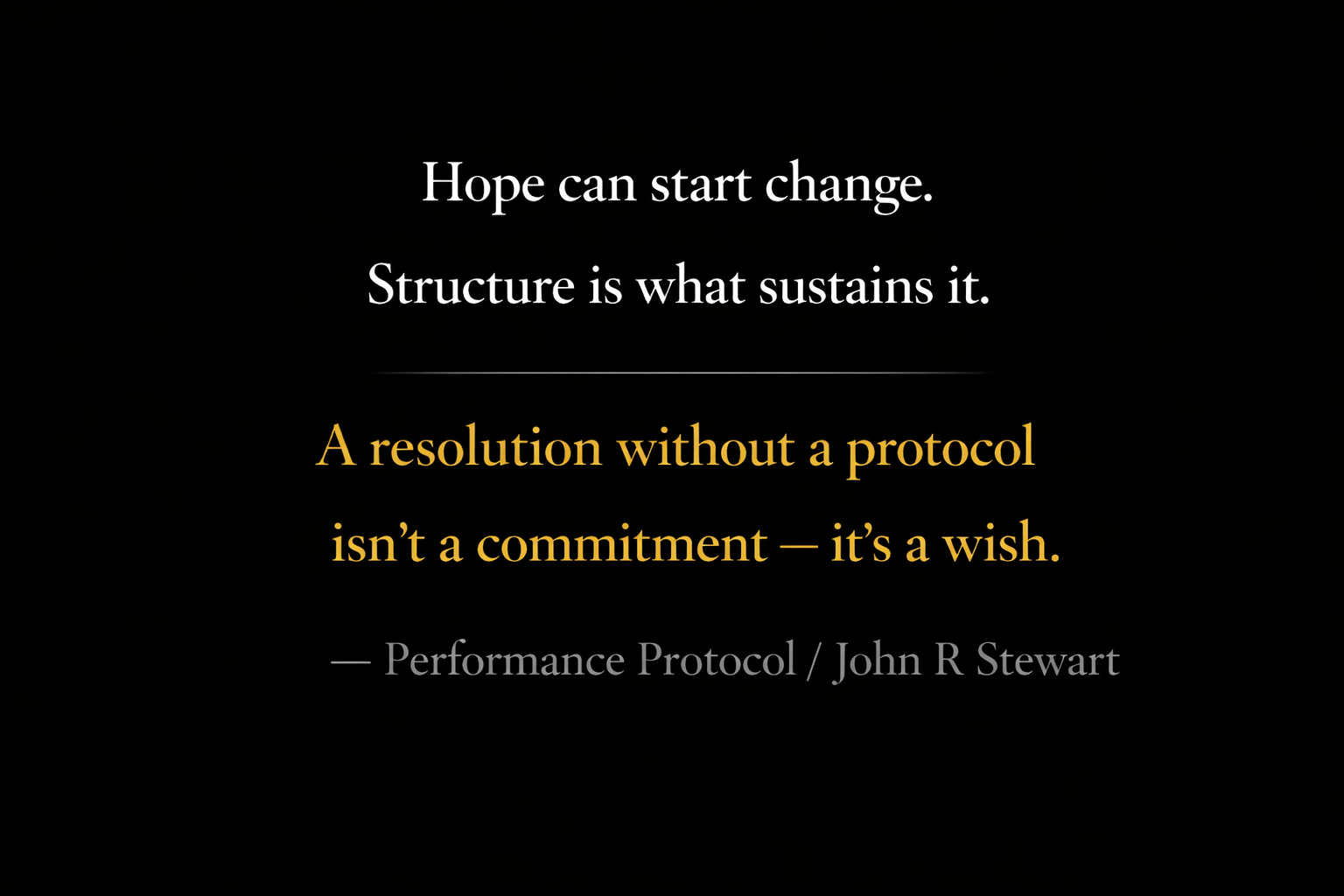
Hope can start movement. Only structure sustains it.
Real change requires:
- clear behaviors, not vague intentions
- measurable feedback, not blind effort
- plans for low-motivation days, not just high-energy ones
If you don’t define what you will do — and what you will do when you don’t feel like doing it — the resolution is already broken.
---
The Rule
A resolution without structure is not a commitment. It’s a wish.
Performance Protocol isn’t about crushing hope. It’s about anchoring it to reality.
Because wanting change isn’t rare. Designing for it is.
And without a protocol, January optimism quietly turns into February resignation — every single year.
Final Protocol Principle
Hope is not something you sustain. It is something that fades unless it is anchored to structure.
Fix the protocol. Consistency will follow.
*Performance Protocol is a system-first approach to human performance — built on physiology, recovery, and real-world constraints.*
*Each article is a layer in the same framework. No hacks. No hype. Just structure.*
Next: How to assemble your personal operating system.
Thanks for reading Performance Protocol AI! Subscribe for free to receive new posts and support my work.