Stress Is Not the Enemy. Unrecovered Stress Is.
Why recovery determines whether stress builds you or breaks you
Most people treat stress like a problem to eliminate.
Thanks for reading Performance Protocol AI! Subscribe for free to receive new posts and support my work.
They avoid it. They manage it. They try to reduce it.
That instinct is understandable — and wrong.
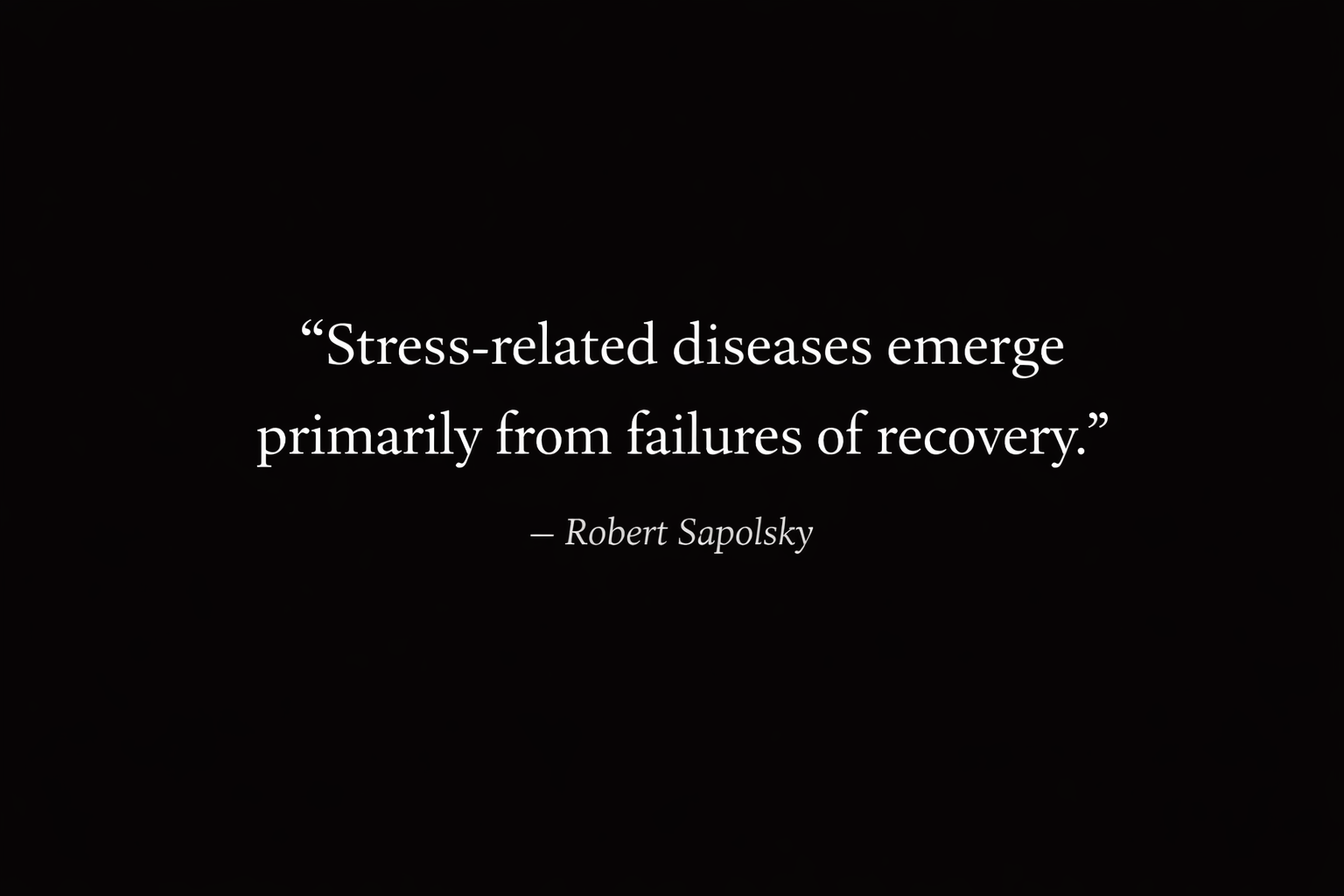
Stress isn’t the enemy. Unrecovered stress is.
Stress Is a Feature, Not a Bug
Stress is how the body adapts.
Every meaningful improvement depends on it:
- Training stresses tissue so it grows stronger
- Cognitive strain builds focus and skill
- Psychological pressure builds resilience
Without stress, nothing improves.
The problem isn’t exposure. The problem is accumulation without recovery.
Why Stress Gets Misdiagnosed
When people feel overwhelmed, they assume:
- They’re doing too much
- They’re not disciplined enough
- They need better coping strategies
In reality, most people aren’t overstressed.
They’re under-recovered.
Sleep is fragmented. Downtime is shallow. The nervous system never fully downshifts.
Stress piles up not because life is hard — but because recovery never completes.
The Nervous System Has Only Two Modes
At a high level, your nervous system oscillates between:
- **Activation** (stress, effort, alertness)
- **Recovery** (repair, consolidation, regulation)
Performance depends on smooth transitions between the two.
Modern life breaks that rhythm.
You train hard. Work late. Scroll at night. Wake early. Repeat.
Activation without resolution becomes noise.
Why “Stress Management” Often Fails
Most stress advice focuses on coping, not recovery.
- Breathing exercises between meetings
- Short meditations layered onto exhaustion
- Productivity tools added to overloaded schedules
These help temporarily — but they don’t close the loop.
You can’t regulate a system that never gets permission to shut down.
Recovery Is an Active Process
Recovery isn’t passive. It’s not “doing nothing.”
It’s a biological state.
Stress activates systems. Recovery turns them back off.
If those off-switches don’t engage, stress hormones stay elevated, tissue repair stalls, and cognition degrades — even if you feel “rested.”
Real recovery requires four conditions.
What Recovery Actually Requires
1. Parasympathetic Activation
The nervous system must exit threat mode.
This doesn’t happen through distraction. It happens through signals of safety.
Effective inputs include:
- Slow nasal breathing with longer exhales than inhales
- Non-stimulating movement (walking, zone-1 cardio)
- Quiet, low-light environments
- Predictable routines that reduce uncertainty
If your downtime still feels mentally loud, recovery hasn’t started.
2. Complete Stress Resolution (Not Just Stress Reduction)
Stress must be completed, not merely paused.
Many people stack:
- Training stress
- Cognitive stress
- Emotional stress
…and never fully resolve any of them.
Resolution looks like:
- Training sessions that stop before failure
- Clear psychological endpoints to workdays
- Deliberate separation between effort and rest
Without closure, stress carries forward.
3. Adequate Sleep Architecture
Sleep is where recovery is finalized.
But it only works when:
- Stress hormones fall overnight
- REM and deep sleep cycles are intact
- The nervous system feels safe enough to downshift
This is why sleep quality collapses under chronic stress, even with sufficient time in bed.
Sleep doesn’t fix unresolved stress. It reflects it.
4. Energy Availability
Recovery is metabolically expensive.
Under-fueling:
- Prolongs cortisol elevation
- Impairs tissue repair
- Increases perceived stress
Many high performers block recovery unintentionally by:
- Training hard
- Eating too little
- Staying lean year-round
A stressed system needs fuel to recover.
When Behavioral Recovery Isn’t Enough
For many people, fixing sleep, workload, and recovery behaviors is sufficient.
For others, the system has been stressed too long.
In those cases, medical support may be appropriate — not as a shortcut, but as scaffolding.
Hormonal & Neuroendocrine Considerations
Chronic stress can dysregulate:
- Cortisol rhythm
- Growth hormone release
- Testosterone or estrogen balance
- Thyroid signaling
When these systems are impaired, recovery capacity drops — regardless of discipline.
In clinically appropriate cases, supervised interventions that support:
- Growth hormone pathways
- Circadian hormone timing
- Autonomic balance
may help restore baseline recovery capacity.
These are not performance enhancers. They are system restoratives.
They work best after sleep and stress inputs are corrected — not instead of them.
Why Most “Stress Treatments” Fail
Most people reach for tools that mask stress rather than resolve it.
- Stimulants to push through fatigue
- Sedatives to force sleep
- Supplements layered onto exhaustion
This treats symptoms, not structure.
You can suppress stress temporarily. You cannot skip recovery permanently.
Eventually, the system collects its debt.
Stress Must Be Cycled, Not Avoided
High performers don’t avoid stress. They cycle it deliberately.
They apply stress intensely — then remove it completely.
Hard days are hard. Easy days are truly easy.
This contrast allows stress to remain useful instead of corrosive.
Without contrast, the system never resets.
The Performance Order Still Applies
This is why Performance Protocol insists on sequence.
You cannot:
- Layer stress on broken sleep
- Train hard on a dysregulated nervous system
- Add cognitive load without recovery capacity
Stress only builds when recovery is intact.
Sequence beats intensity.
What Reliability Looks Like Under Stress
A regulated system doesn’t feel calm all the time.
It feels:
- Responsive instead of reactive
- Tired without being depleted
- Pressured without being overwhelmed
Stress shows up — then leaves.
That’s not stress-free living. That’s stress done correctly.
Final Thought
Stress is not the enemy.
It’s the signal.
If stress is breaking you, the answer isn’t less pressure. It’s more complete recovery.
Close the loop.
—
Performance Protocol
Performance Protocol is a system-first approach to human performance — built on physiology, recovery, and real-world constraints.
*Each article is a layer in the same framework. No hacks. No hype. Just structure.*
Next: Why Motivation Fails (and Systems Don’t)
Thanks for reading Performance Protocol AI! Subscribe for free to receive new posts and support my work.