Positive Motivation vs. Negative Motivation
Why what pulls you forward matters more than what you’re running from
Most people don’t fail because they lack motivation. They fail because they choose the wrong kind.
Thanks for reading Performance Protocol AI! Subscribe for free to receive new posts and support my work.
There are two forces that move behavior:
Negative motivation — avoidance Positive motivation — direction
They are not equal. They do not compound the same way. And one quietly burns people out.
Negative Motivation: Running From Shame
Negative motivation sounds like:
- “I don’t want to look fat”
- “I don’t want to embarrass myself”
- “I don’t want to be judged at the reunion”
- “I don’t want to feel behind”
This works—briefly.
Fear and shame can generate short bursts of action. They’re powerful, but unstable.
Once the threat disappears:
- The reunion passes
- The meeting ends
- The comment is forgotten
So does the behavior.
Negative motivation creates reactive effort, not identity change.
You move away from something, but you don’t know where you’re going.
Positive Motivation: Moving Toward Meaning
Positive motivation sounds different:
- “I want to be healthy enough to be present for my kids”
- “I want energy that lasts past 6 p.m.”
- “I want a body that supports the life I’m building”
- “I want consistency, not extremes”
This kind of motivation isn’t loud. It doesn’t spike adrenaline.
But it endures.
Because it’s tied to:
- Values
- Responsibility
- Long-term identity
You don’t stop caring when no one’s watching.
The Core Difference
Negative motivation asks:
“What do I want to avoid?”
Positive motivation asks:
“Who do I want to be reliable for?”
Avoidance is fragile. Meaning is durable.
Why Performance Protocol Rejects Shame
Shame-based motivation:
- Encourages all-or-nothing behavior
- Rewards extremes
- Collapses under stress
It creates cycles: Motivation → burnout → guilt → restart
Positive motivation creates systems instead of cycles.
You don’t need to hate your body to take care of it. You don’t need fear to be disciplined. You don’t need self-contempt to change.
The Protocol Rule
If your motivation disappears when the pressure is gone, it was never strong enough to build a system.
Performance Protocol is built on pull, not push.
You design habits around:
- Who depends on you
- The life you’re responsible for sustaining
- The person you want your kids to see every day
Not a mirror. Not a scale. Not a room full of people you barely know.
The Reframe
“I want to be healthier” isn’t enough.
But this is:
“I want to be strong enough to show up consistently—for my kids, my work, and myself—for decades.”
That motivation doesn’t expire. It doesn’t need hype. It survives bad weeks.
---
The Rule (Final)
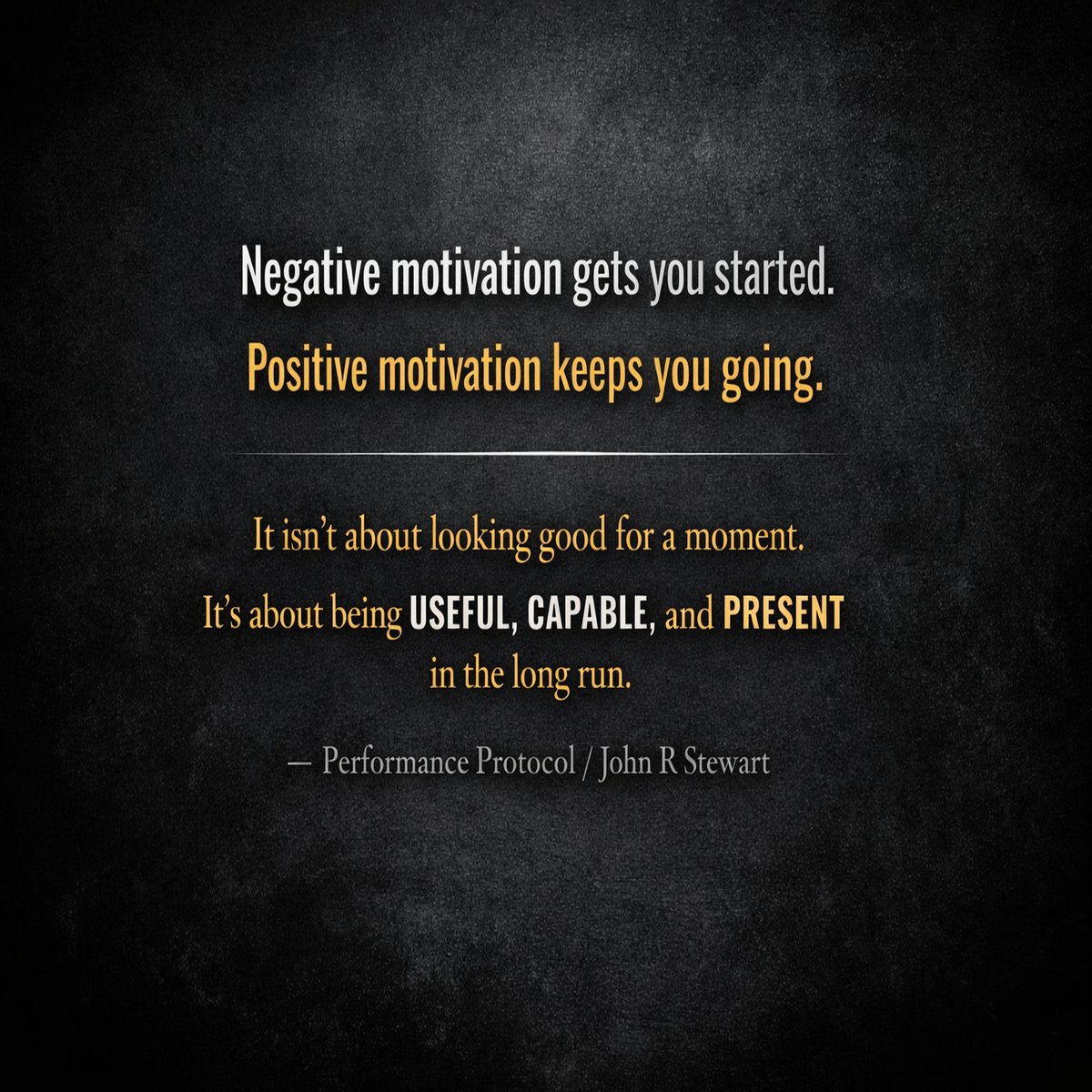
Negative motivation gets you started. Positive motivation keeps you going.
Performance Protocol isn’t about looking good for a moment. It’s about being useful, capable, and present for the long run.
*Performance Protocol is a system-first approach to human performance — built on physiology, recovery, and real-world constraints.*
*Each article is a layer in the same framework. No hacks. No hype. Just structure.*
Thanks for reading Performance Protocol AI! Subscribe for free to receive new posts and support my work.