Discipline Is a Consequence, Not a Trait
Consistency as an emergent property
Discipline is one of the most over-moralized concepts in modern culture.
It’s treated as a personality trait. Something you either have or don’t. A marker of character, grit, or superiority.
This framing is wrong—and damaging.
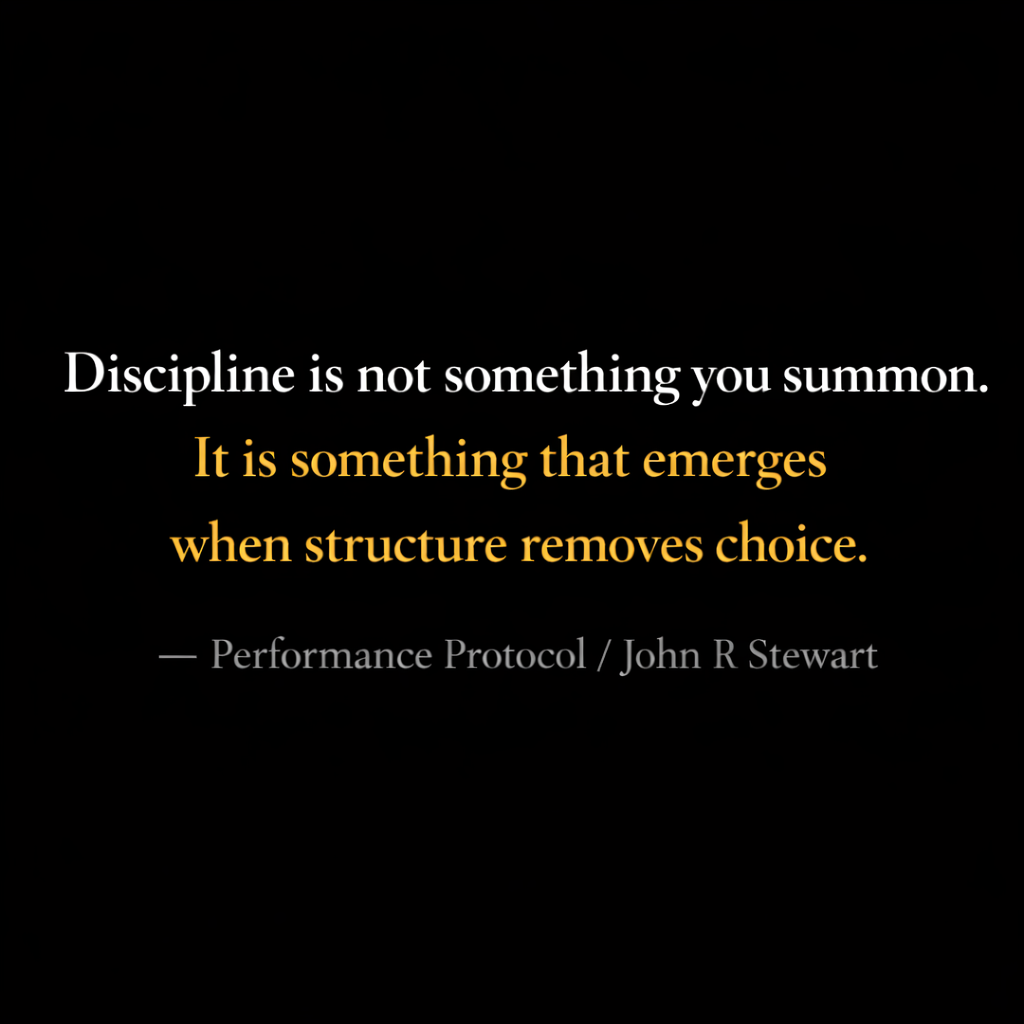
**Discipline is not the cause of consistent behavior. It is the result of systems that remove the need for choice.**
---
The Discipline Narrative Is Backwards
When people fail to stay consistent, they assume:
- They lack discipline
- They’re not wired correctly
- They just need to “try harder”
But look closely at anyone widely considered disciplined.
They don’t make heroic daily decisions. They don’t rely on willpower. They don’t negotiate with themselves.
They repeat behaviors inside structured constraints.
What you’re observing isn’t discipline. It’s environmental inevitability.
---
Consistency Is Not a Skill
It’s an Output
Consistency emerges when:
- The correct action is easy to start
- The wrong action requires friction
- The decision has already been made
This is why:
- Scheduled training beats “listening to your body”
- Meal prep beats dietary restraint
- Checklists beat memory
- Calendars beat intention
No discipline required.
---
Why Willpower Fails Under Pressure
Under stress:
- Cognitive load increases
- Executive function degrades
- Decision quality collapses
This is not weakness. It’s biology.
If your system requires discipline to function, it will fail precisely when you need it most.
Stress doesn’t create failure. It reveals system design flaws.
---
Discipline as a Lagging Indicator
Discipline is a lagging indicator, not a leading one.
You don’t become disciplined and then act consistently. You act consistently because your system enforces repetition—and discipline is the label applied after the fact.
This is why people misattribute success to character instead of structure.
---
The Performance Protocol Reframe
Stop asking:
“How do I become more disciplined?”
Start asking:
“What structure would make this behavior unavoidable?”
This single question shifts responsibility from personality to design—where it belongs.
---
Non-Negotiables Create Freedom
High performers operate with non-negotiables, not motivation.
Non-negotiables are:
- Pre-decided
- Time-bound
- Identity-aligned
- Immune to mood
Examples:
- Training happens at the same time every day
- Devices stay out of the bedroom
- Work begins after movement
- Alcohol is limited to defined windows
Once something is non-negotiable, discipline becomes irrelevant.
---
Identity Follows Repetition
People don’t act disciplined because they are disciplined. They become disciplined because repetition reshapes identity.
Structure → Repetition → Identity → Consistency
Not the other way around.
---
The Real Cost of Getting This Wrong
When discipline is framed as a trait:
- Failure feels personal
- Shame replaces diagnosis
- Systems never get redesigned
When discipline is framed as an outcome:
- Failure becomes data
- Friction gets adjusted
- Consistency compounds
One approach stalls. The other scales.
---
Final Protocol Principle
**Discipline is not something you summon. It is something that emerges when your environment, systems, and identity are aligned.**
Fix the structure. Consistency will follow.
Performance Protocol is a system-first approach to human performance — built on physiology, recovery, and real-world constraints.
*Each article is a layer in the same framework. No hacks. No hype. Just structure.*
---
Next: Your Environment Is the Algorithm